The Invisible Gap in Aviation Compliance: Why Aircraft Records Break Down Across Systems — Not Processes
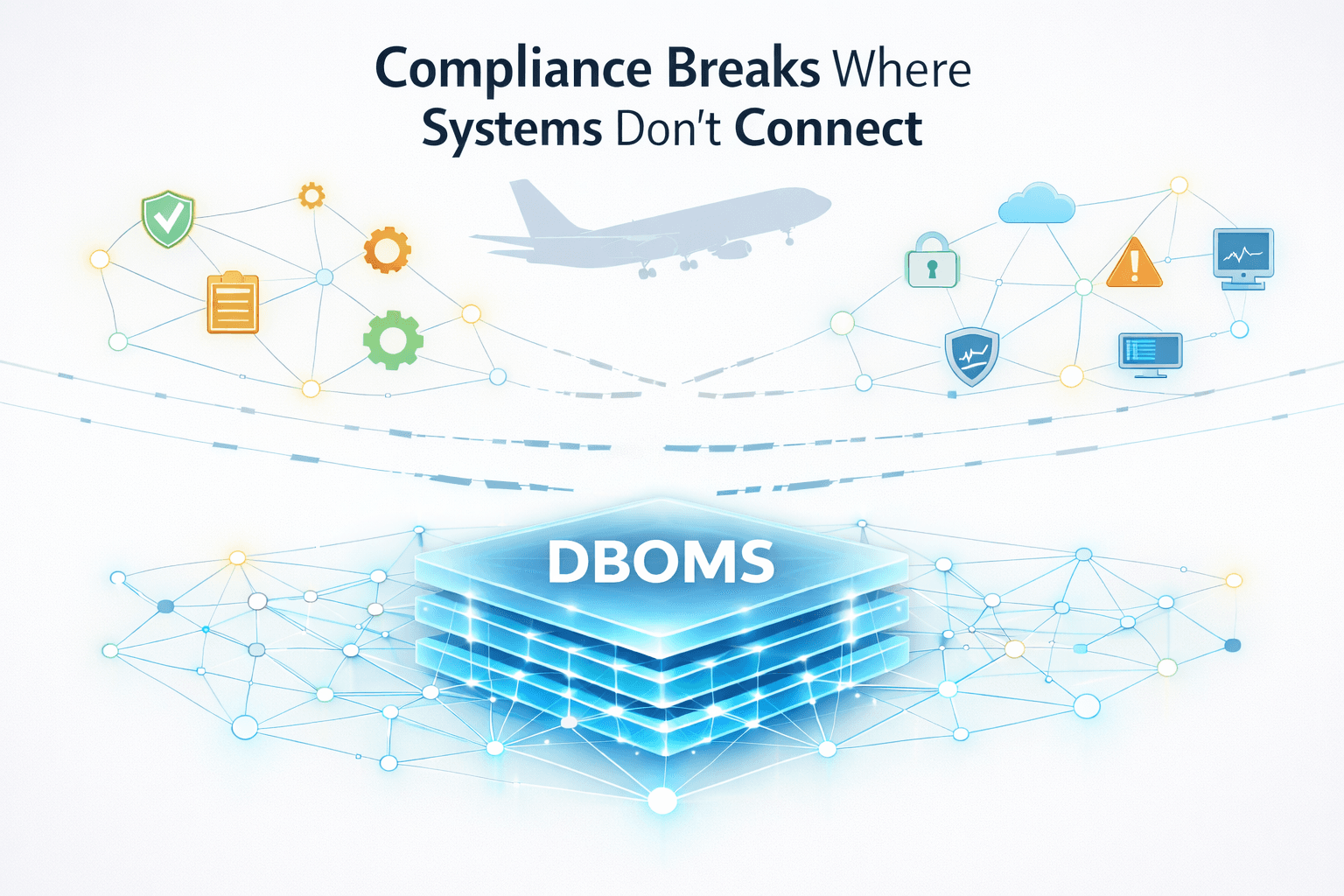
✈️ Compliance Is Not Failing — Systems Are
In aviation, compliance has always been treated as a function of:
- discipline
- process adherence
- documentation accuracy
Organizations invest heavily in SOPs, training, and regulatory alignment.
Yet in 2026, audit findings are increasing—even in well-managed environments.
This reveals a deeper issue:
**Compliance is not failing at the process level. It is failing at the system level.**
⚠️ The Shift: From Process Compliance to System Integrity
Modern aviation audits have evolved.
Earlier, auditors checked:
- whether processes were followed
- whether documents existed
Today, they verify:
- how records are connected
- whether actions are traceable
- whether systems can prove consistency over time
This means:
**Compliance is no longer about documentation. It is about system integrity.**
🧠 The Core Problem: Multi-System Aviation Ecosystem
Aviation operations involve multiple stakeholders:
- Airlines
- CAMO teams
- MRO providers
- Lessors
Each operates its own systems and workflows.
While each system performs independently, there is no unified layer connecting them.
This leads to:
- fragmented data
- disconnected records
- incomplete compliance narratives
Data exists.
But it cannot be interpreted as a complete system.
🧩 Where Aircraft Records Break Down
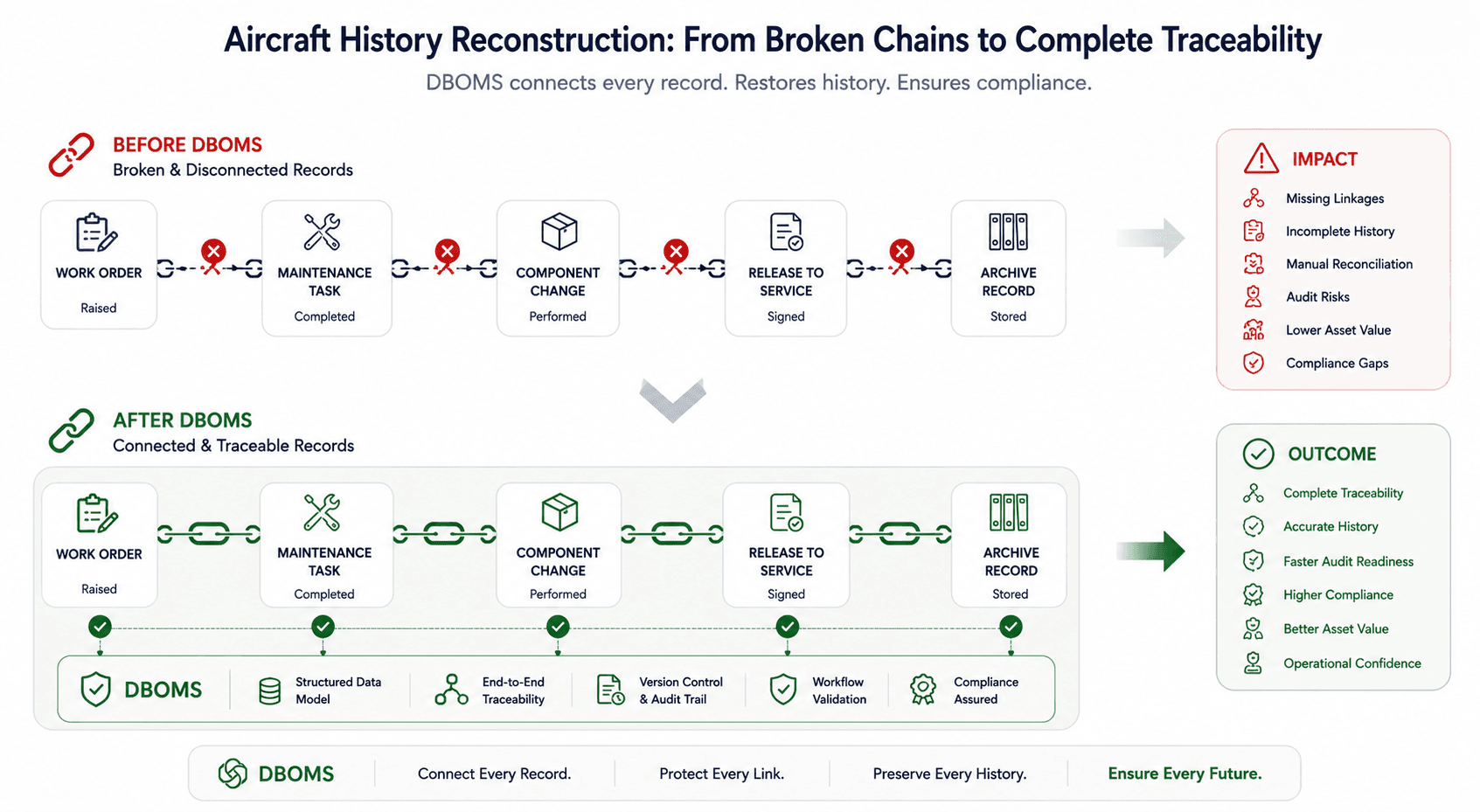
The issue is not missing documents.
It is missing relationships between documents.
Typical breakdown:
- maintenance logs not linked to approvals
- approvals not linked to revisions
- revisions not linked to compliance checks
- records stored without context
Each record exists independently.
But compliance requires them to exist as a connected sequence.
Without that structure:
Compliance appears incomplete—even when data exists.
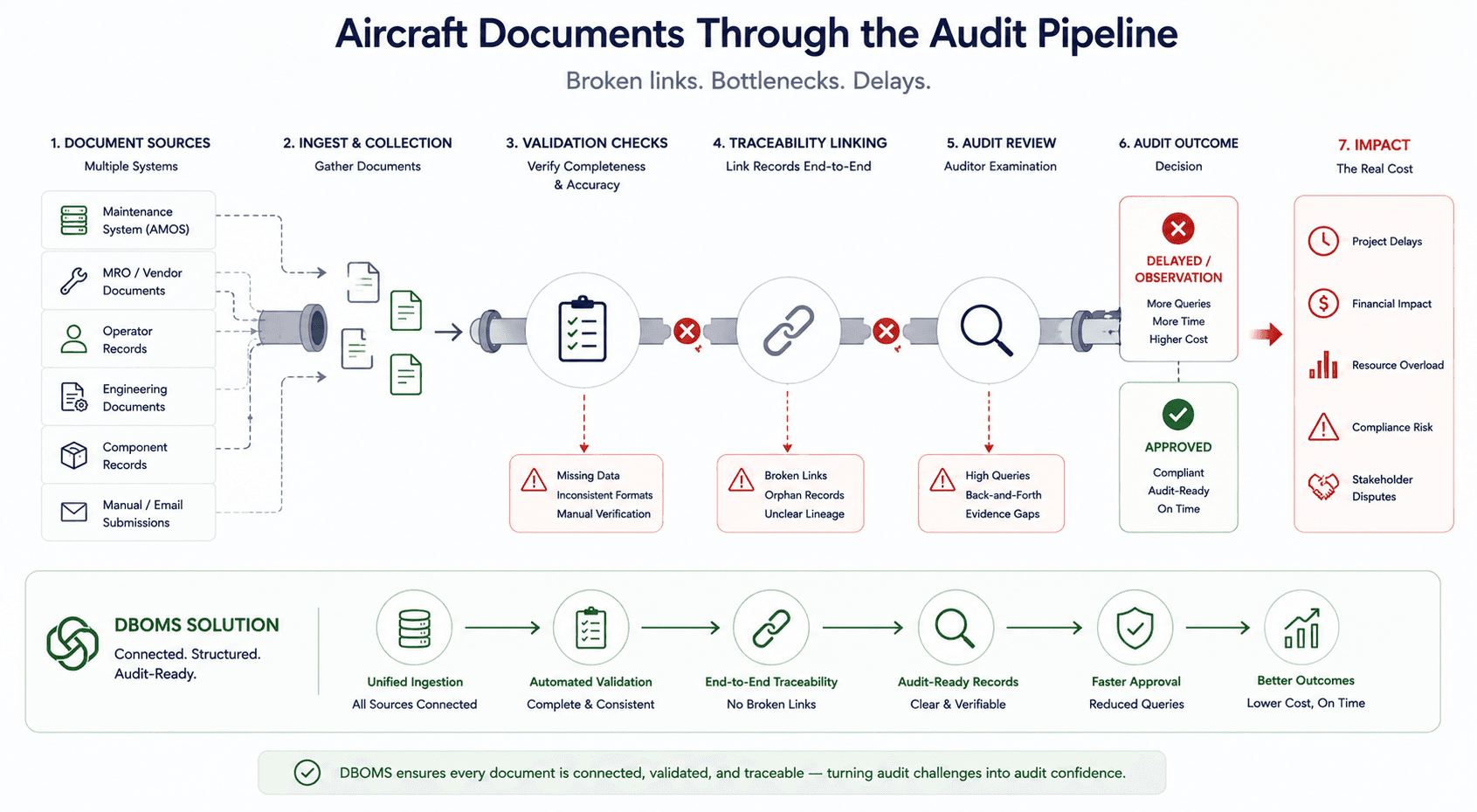
💥 Real Audit Scenario
Auditor request:
“Show the full trace of this maintenance activity.”
This requires:
- maintenance log
- approval record
- revision history
- compliance validation
In fragmented systems:
- data must be collected manually
- multiple teams are involved
- delays occur
- inconsistencies appear
Result:
- reduced audit confidence
- increased regulatory scrutiny
📉 Business Impact of System-Level Gaps
Disconnected systems directly impact operations:
- delayed aircraft readiness
- increased audit findings
- grounding risks
- contract loss for MRO providers
- delays in aircraft transitions for lessors
Compliance inefficiency becomes a business risk, not just an audit issue.
📊 Why This Problem Is Growing in 2026
Aviation complexity is increasing:
- higher aircraft utilization
- more leasing cycles
- multi-country operations
- stricter regulatory expectations
At the same time:
- legacy systems remain storage-focused
- data remains siloed
This creates a gap between:
operational complexity vs system capability
And that gap is where compliance fails.
🚀 The Required Shift: From Storage to Structured Systems
To solve this, aviation organizations must move from:
- storing documents
to
- structuring relationships between records
This means:
- linking records across workflows
- preserving context across time
- ensuring traceability across systems
Compliance must be built into the system—not reconstructed during audits.
⚙️ How DBOMS Solves This Problem
DBOMS introduces a relational record architecture.
Instead of storing documents in isolation, it connects them through:
- workflows
- approvals
- dependencies
- lifecycle stages
🔗 1. Connected Record Structure
Every record in DBOMS is linked to:
- its originating process
- its approval chain
- its related documents
- its lifecycle stage
This creates a complete compliance chain.
🔄 2. Workflow-Driven Traceability
DBOMS enforces structured workflows:
Draft → Review → Approval → Active → Audit Log
Each step is:
- time-stamped
- role-based
- non-skippable
Traceability becomes automatic.
📜 3. Full Lifecycle Visibility
DBOMS maintains:
- version history
- change justification
- approval lineage
- historical context
Auditors can see:
- what changed
- when
- why
- under whose authority
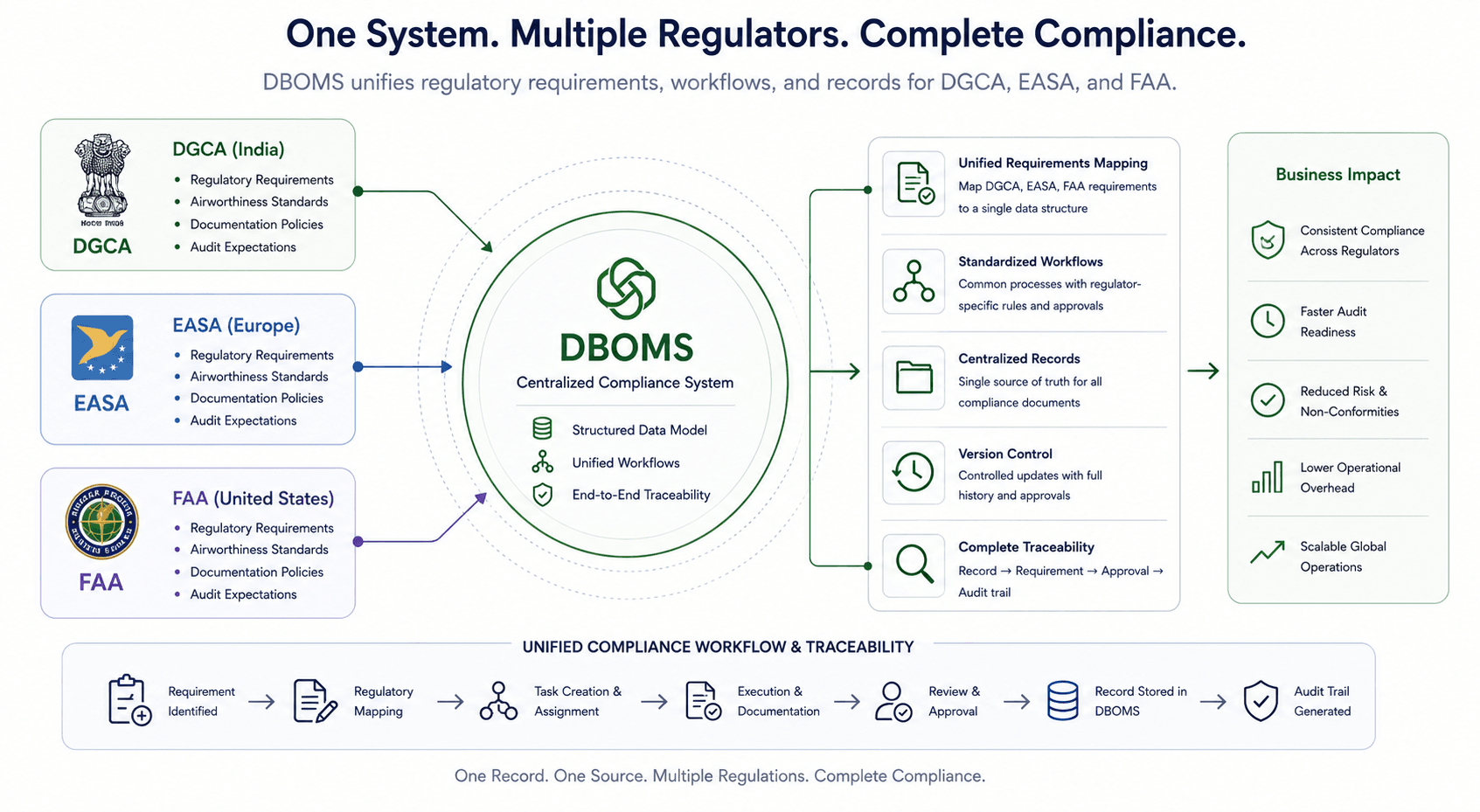
🌐 4. Unified System Across Stakeholders
DBOMS allows:
- CAMO
- MRO
- Lessors
to operate within one structured system.
This eliminates:
- data silos
- manual coordination
- disconnected records
📈 Strategic Advantage of Structured Compliance
Organizations using DBOMS gain:
- instant audit response capability
- reduced audit preparation time
- improved inter-team coordination
- predictable compliance outcomes
Compliance becomes:
- controlled
- measurable
- scalable
🧭 Final Perspective
Aviation compliance challenges are not caused by weak processes.
They are caused by systems that cannot represent relationships between records.
The future of compliance depends on:
- structured data
- connected workflows
- system-level traceability
📌 Final Thought
The question is no longer:
“Do you have the records?”
It is:
“Can your system prove the full story behind them?”
Because in modern aviation:
**Compliance is not storage. It is provability through structure.**
DBOMS — Turning Aviation Records into a Connected Compliance System.