Why Compliance Failure Is Often a Document Issue — And How DBOMS Prevents It
Compliance Doesn’t Fail Where You Think It Does
When organizations face compliance issues, the first assumption is:
- finance error
- operational gap
- human mistake
But in reality, most compliance failures originate somewhere quieter:
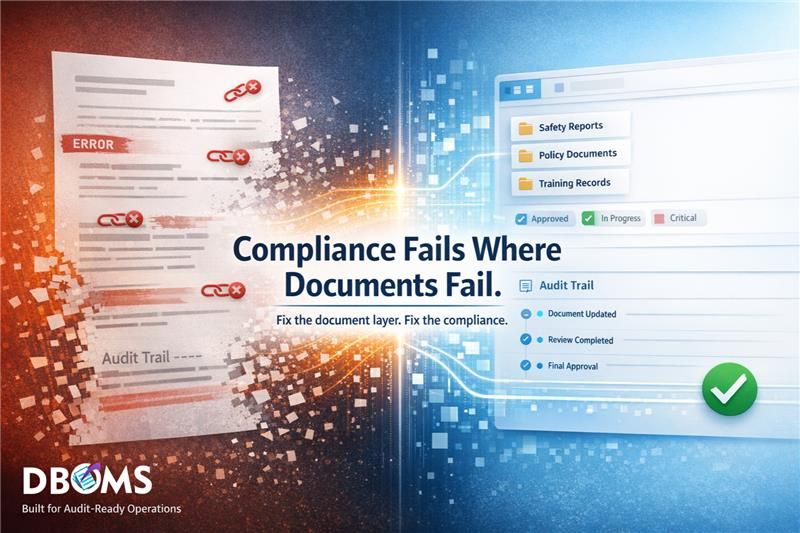
the document layer.
Missing approvals. Wrong versions. Untraceable changes. Incomplete records.
These are not minor issues.
They are compliance failures waiting to happen.
The Hidden Truth: Compliance Is Document-Driven
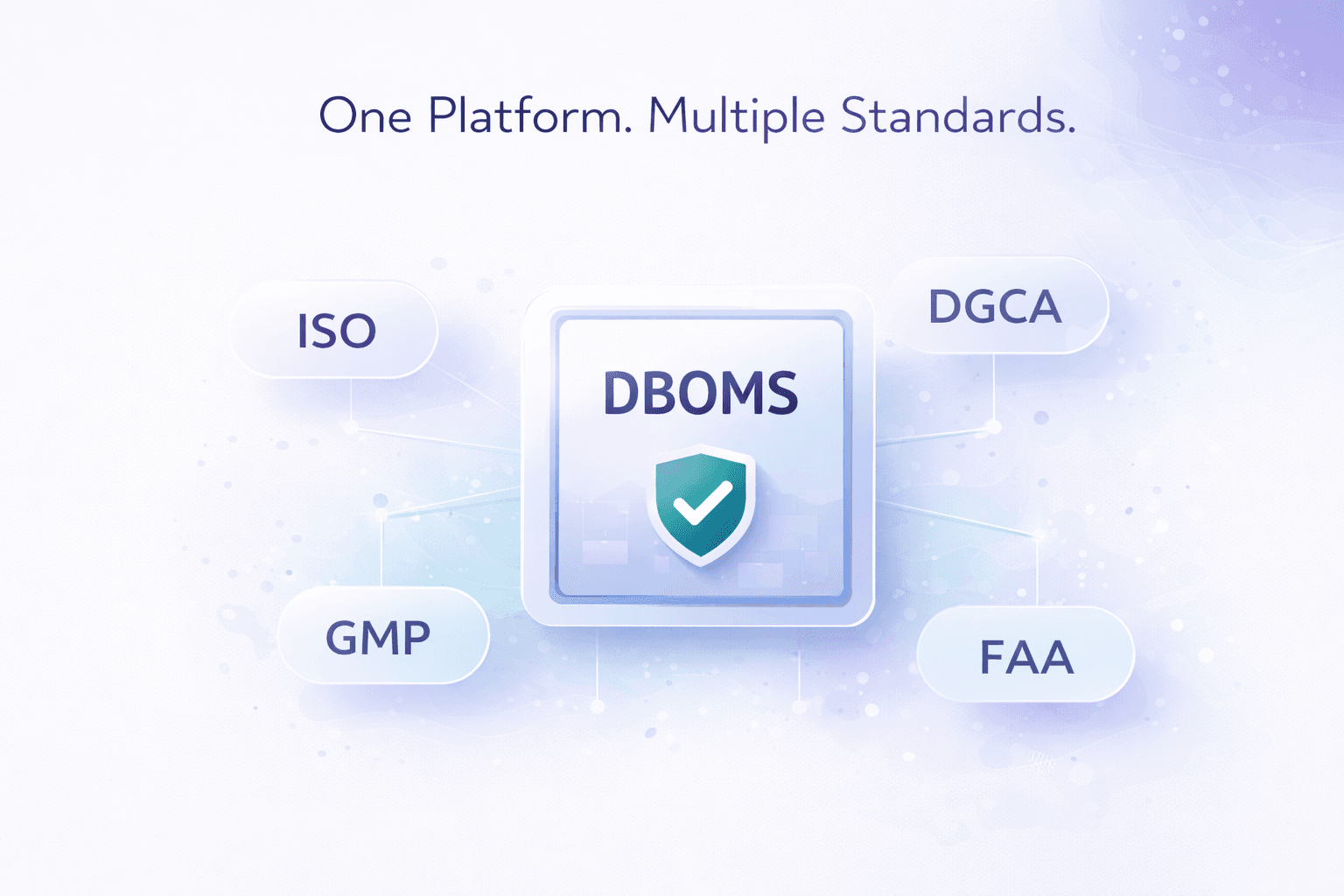
Every compliance framework—ISO, GMP, DGCA, FAA—relies on documentation.
Not just the existence of documents, but their:
- accuracy
- version integrity
- approval traceability
- lifecycle control
Compliance is not proven by processes.
It is proven by records of those processes.
If documents are weak, compliance collapses—no matter how strong operations are.
Common Document-Level Failures That Break Compliance
Most organizations do not fail intentionally.
They fail structurally.
| Document Issue | What Happens | Compliance Impact |
|---|---|---|
| Missing approval proof | Approvals done via email or verbally | No audit traceability |
| Version confusion | Multiple “final” files exist | Wrong document used |
| No document lifecycle control | Outdated files remain active | Non-compliance risk |
| Scattered storage | Files across drives and folders | Delayed audits |
| No audit trail | Changes not recorded | Accountability gaps |
Auditors rarely start by asking:
“Do you have the document?”
They ask:
“Can you prove how this document was created, approved, and used?”
That is where most systems fail.
Why Traditional Systems Cannot Prevent These Failures
Traditional systems treat documents as static files.
They focus on storage, not control.
Common limitations include:
- no enforced workflow
- no mandatory approval stages
- manual version tracking
- no structured audit trail
- dependency on human discipline
This creates an environment where:
- documents exist without context
- approvals exist without proof
- records exist without traceability
Compliance becomes reactive instead of controlled.
DBOMS: Preventing Compliance Failure at the Source
DBOMS approaches compliance differently.
It does not fix audits.
It fixes the system that produces audit evidence.
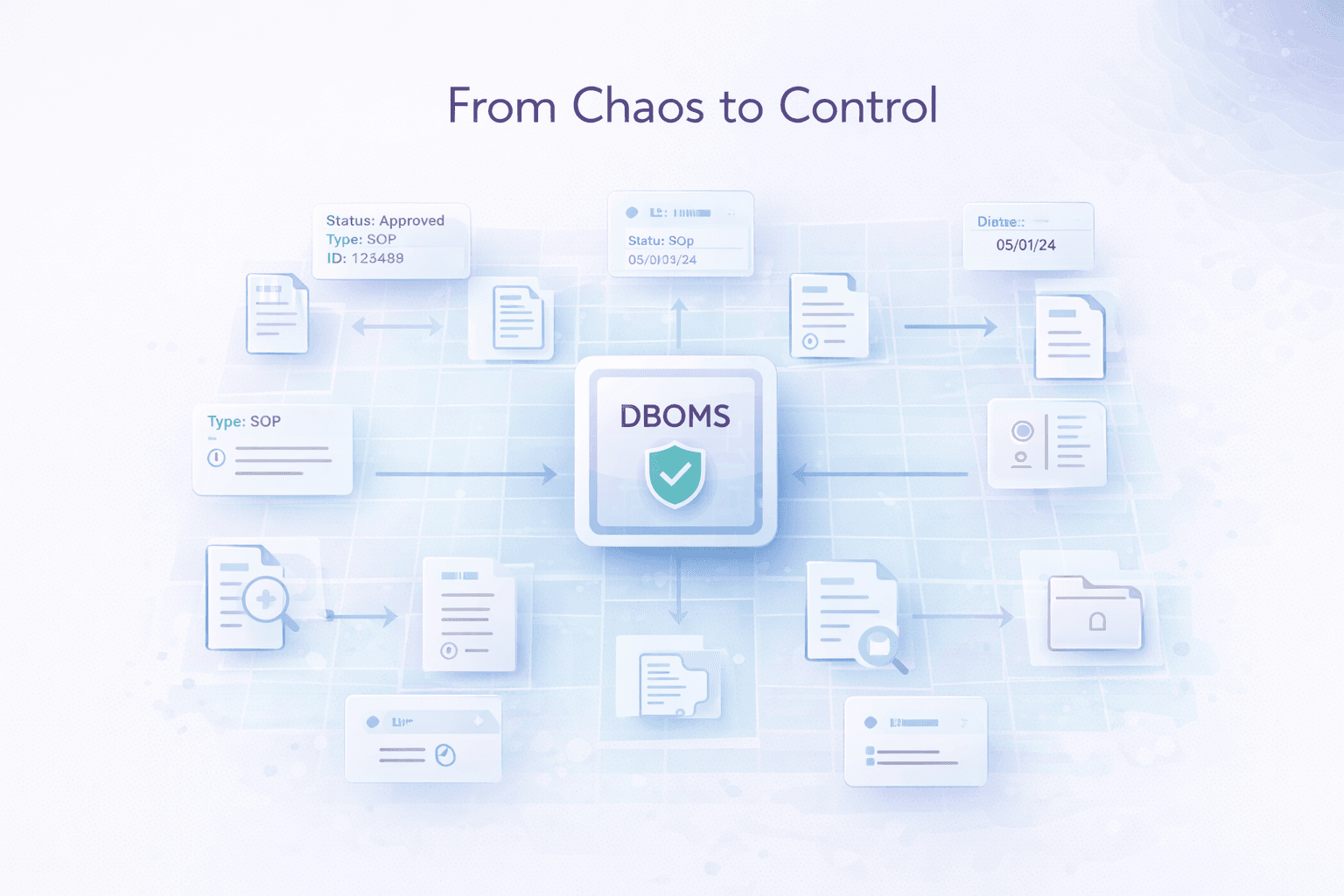
Every document inside DBOMS is treated as a controlled record, not just a file.
1. Structured Document Creation
Every document in DBOMS begins with:
- defined ownership
- department association
- mandatory metadata
- linked workflow
No uncontrolled uploads.
Every document starts with compliance context.
2. Workflow-Enforced Approvals
DBOMS ensures documents follow structured workflows:
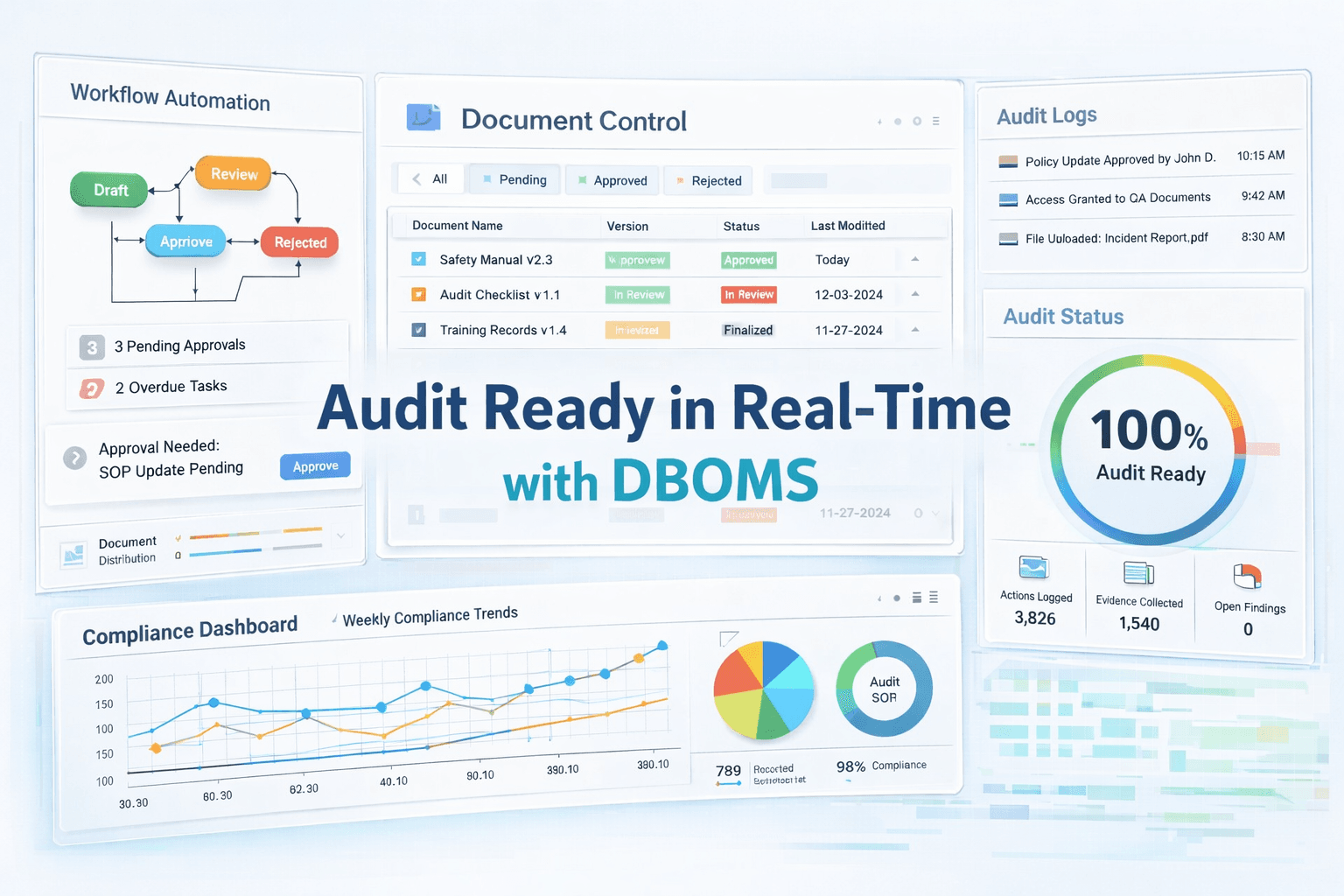
Draft → Review → Approval → Active → Archived
Each step is:
- mandatory
- time-stamped
- role-based
- non-skippable
Approvals are no longer informal.
They are system-enforced.
3. Version Control That Eliminates Confusion
DBOMS maintains complete version history:
- one active version at a time
- previous versions archived but traceable
- full visibility into changes
Users cannot accidentally use outdated documents.
Auditors can trace document evolution instantly.
4. Built-In Audit Trails
Every action inside DBOMS is recorded automatically:
- document edits
- approvals and rejections
- workflow transitions
- access activity
Each event includes:
- user identity
- timestamp
- action details
This creates a continuous, tamper-proof audit trail.
5. Lifecycle Control Prevents Risk
DBOMS manages the entire document lifecycle:
- creation
- review
- approval
- active use
- periodic review
- supersession
- archival
Outdated documents are automatically restricted.
Only valid records remain in use.
This prevents one of the most common compliance failures:
using the wrong document.
📊 Before vs After DBOMS
| Area | Without DBOMS | With DBOMS |
|---|---|---|
| Document control | Manual | Structured |
| Approvals | Email-based | Workflow-driven |
| Version tracking | Confusing | Automatic |
| Audit trails | Missing | Built-in |
| Compliance readiness | Reactive | Continuous |
Why Fixing Documents Fixes Compliance
Compliance failures are rarely caused by lack of effort.
They are caused by lack of structure.
When documents are:
- controlled
- versioned
- traceable
- workflow-driven
compliance becomes automatic.
DBOMS removes dependency on memory, emails, and manual tracking.
It replaces them with system-enforced control.
Final Perspective
Compliance does not fail at the audit.
It fails long before that—at the document level.
Organizations that fix document control:
- reduce audit risk
- improve operational clarity
- eliminate compliance surprises
DBOMS ensures that every document:
- has a history
- has an owner
- has an approval path
- has proof
Because in compliance, documentation is not support.
It is evidence.