Why Global Compliance Requires Local Digital Tools
🌍 Global Compliance Sounds Unified — Until Operations Begin
Every organization operating across multiple regions faces the same challenge:
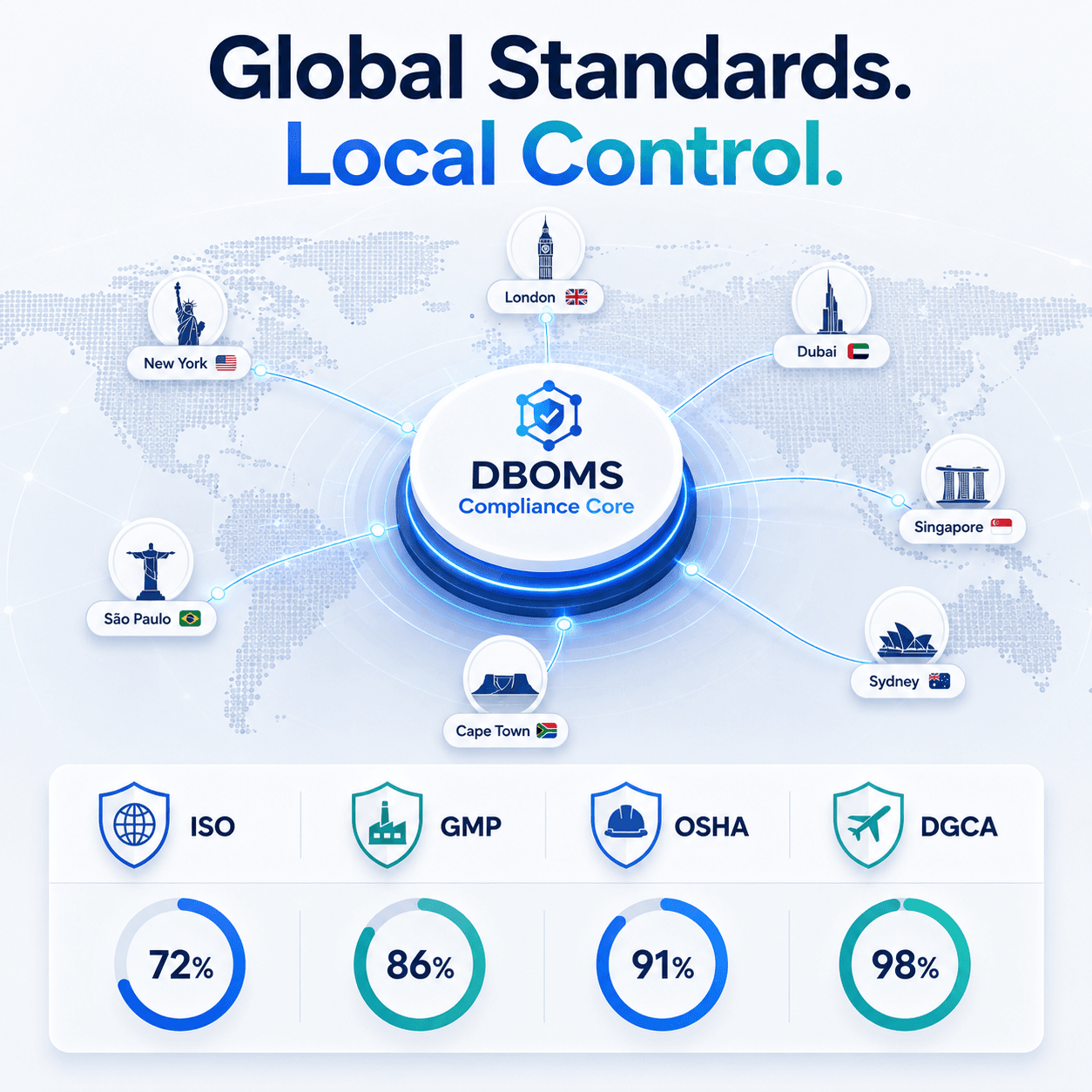
Global standards are universal. Operations are not.
Frameworks like:
- ISO
- GMP
- OSHA
- DGCA
define what organizations must achieve.
But every country, department, and operational unit follows different workflows, documentation structures, approval chains, and audit expectations.
This creates a critical reality:
Global compliance cannot succeed with rigid systems.
It requires local adaptability inside a centralized structure.
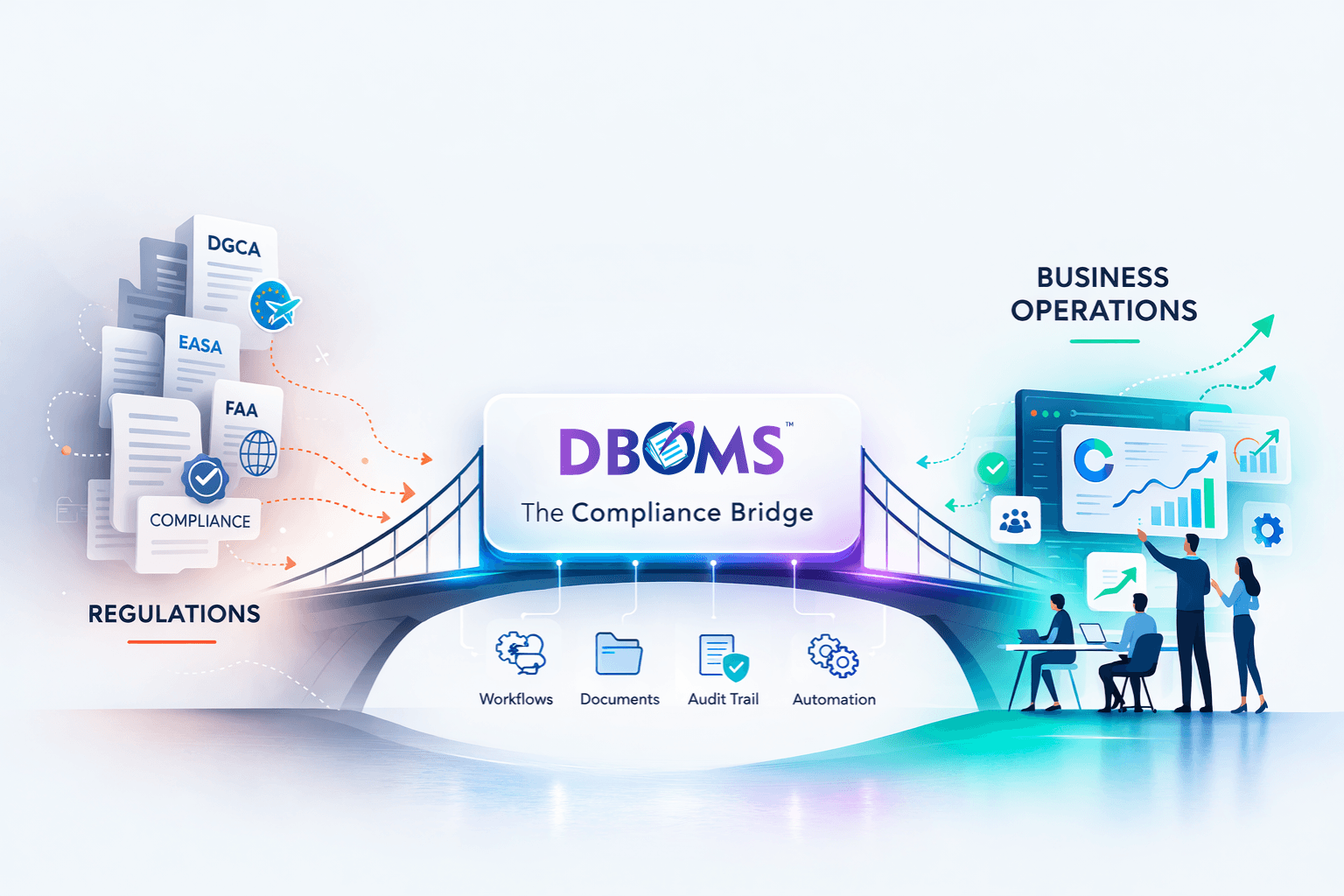
That is exactly where DBOMS (Digital Back Office Management System) changes how compliance is managed.
⚠️ The Problem with Traditional Compliance Systems
Most compliance systems are built around fixed structures.
They assume:
- every department works the same
- every country follows identical processes
- one workflow fits all operations
In reality:
| Compliance Need | Operational Reality |
|---|---|
| ISO process standardization | Different site-level workflows |
| GMP document control | Region-specific review structures |
| OSHA safety procedures | Local operational variations |
| DGCA audit traceability | Multiple aviation stakeholders |
This mismatch creates:
- compliance gaps
- duplicate systems
- audit inconsistencies
- manual workarounds
Organizations become compliant on paper—but fragmented in execution.
🧠 Why Local Digital Tools Matter
Compliance is not just about storing policies.
It is about operational execution.
Each region or department needs flexibility to:
- configure workflows
- assign approval structures
- define local rules
- adapt lifecycle controls
- track operational compliance status
Without local adaptability, teams create unofficial processes outside the system.
That is where compliance loses integrity.
⚙️ DBOMS: One Platform for Global Compliance Management
DBOMS is designed around a core principle:
Global governance requires local configurability.
Instead of forcing every operation into one rigid workflow, DBOMS allows organizations to configure:
- compliance structures
- approval flows
- document lifecycles
- audit rules
- workflow stages
while maintaining centralized visibility and control.
🧩 How DBOMS Adapts Compliance Across Regions
🌐 1. Configurable Compliance Frameworks
DBOMS supports custom compliance configurations for:
- ISO
- GMP
- OSHA
- DGCA
- FAA
- Internal enterprise policies
Organizations can define:
- mandatory workflows
- approval structures
- review frequencies
- retention rules
- audit requirements
This allows compliance to match operational reality.
🔄 2. Department and Region-Specific Workflows
Different teams operate differently.
DBOMS enables separate workflows for:
- QA
- Operations
- Compliance
- CAMO
- MRO
- Manufacturing plants
- Regional offices
Example:
Aviation maintenance approval flow may differ between countries, but DBOMS manages both within one structured system.
No duplicate platforms required.
📊 3. Real-Time Compliance Visibility
DBOMS provides centralized dashboards showing:
- compliance completion percentage
- pending reviews
- audit readiness indicators
- expired or overdue records
- workflow bottlenecks
Leadership can instantly see:
- which region is compliant
- where risks exist
- how much compliance progress is completed
Compliance becomes measurable—not assumed.
📜 4. Structured Audit Traceability
Every action inside DBOMS is automatically logged:
- document uploads
- approvals
- workflow transitions
- review cycles
- version updates
This creates a live audit trail across all locations and departments.
Auditors no longer need manually assembled evidence.
The system already contains the full compliance story.
🔐 5. Controlled Access Across Global Operations
DBOMS enforces:
- region-level access control
- department-specific visibility
- role-based permissions
- audit logging for every action
This allows organizations to operate globally while maintaining secure local governance.
🏭 Real Industry Examples
| Industry | Compliance Challenge | DBOMS Solution |
|---|---|---|
| Aviation | DGCA + FAA operational traceability | Unified CAMO/MRO workflows |
| Pharma | GMP and 21 CFR Part 11 validation | Version-controlled approvals |
| Manufacturing | ISO process consistency across plants | Configurable local workflows |
| Oil & Gas | OSHA and operational safety compliance | Audit-ready inspection records |
Different regulations. One controlled platform.
📊 Traditional Systems vs DBOMS
| Area | Traditional Systems | DBOMS |
|---|---|---|
| Workflow flexibility | Limited | Fully configurable |
| Regional adaptation | Difficult | Built-in |
| Compliance tracking | Manual | Real-time dashboards |
| Audit preparation | Reactive | Continuous |
| Visibility | Fragmented | Centralized |
| Compliance status tracking | Limited | Percentage-based indicators |
🚀 Why Global Compliance Needs Configurable Systems
Modern compliance environments are becoming:
- more complex
- more regionalized
- more audit-driven
- more traceability-focused
Rigid systems cannot adapt fast enough.
DBOMS solves this by combining:
- centralized governance
- local flexibility
- structured workflows
- real-time visibility
This transforms compliance from a reporting exercise into an operational system.
🧭 Final Perspective
Global compliance does not fail because organizations lack standards.
It fails because systems cannot adapt standards to real operations.
DBOMS bridges that gap by allowing organizations to:
- configure compliance locally
- manage operations globally
- track progress continuously
- maintain audit readiness everywhere
Because modern compliance is not just about rules.
It is about having systems capable of enforcing them intelligently.
DBOMS — One Unified Platform for Global Compliance Control.
Book a demo to see how DBOMS adapts compliance frameworks across countries, departments, and operational environments.